Why Does No One Live On Delos, And Can A Tour Stay Overnight?
Delos is an uninhabited archaeological site with no accommodation, so no tour can stay overnight. The history of why nobody lives there, the last-boat timing, and what a day trip actually looks like.
No one lives on Delos because it is a protected, uninhabited archaeological site, empty since the 7th century AD, and it has no accommodation at all. No tour can stay overnight: every guided visit, cruise and transfer ends with a boat back to Mykonos, Paros or Naxos the same day. The site has been UNESCO World Heritage since 1990, listed under criteria (ii), (iii), (iv) and (vi).
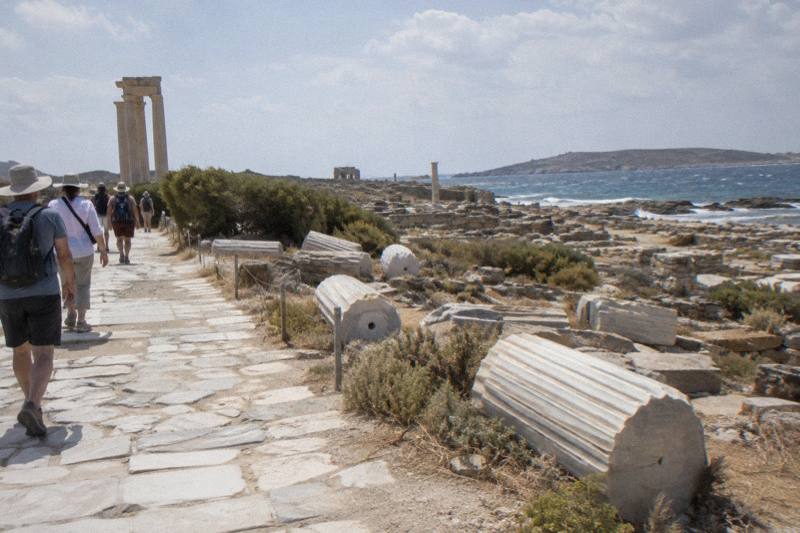
That short answer settles the practical question, but the reason behind it is one of the stranger stories in the Aegean. Delos is not a village that emptied out, or an island people gradually left for the mainland. It was deliberately emptied, twice over: once by religious law in antiquity, when births and deaths were forbidden on the island and the inhabitants were exiled, and then by history itself, with the island sacked in 88 BC and again in 69 BC before falling silent for good. The UNESCO listing for Delos records the site as an uninhabited archaeological island, and that status is exactly what makes a visit feel so unusual: you step off the boat onto a place with no corner shop, no houses, no traffic and nobody at all going about an ordinary day.
The practical consequence for travellers is simple. Whatever tour you book, whether a 4-hour guided half-day or a 7-hour Delos and Rhenia cruise, the return leg is built in and is not optional. Even the roster's longest options, the 8-hour private boats and the 9-hour private yacht tour, are same-day trips. There is no sunset-to-sunrise product anywhere on the market, because there is nowhere on the island to sleep and no permission to try.
This matters more than it might first appear. Delos sits in the middle of the Cyclades, a short hop from Mykonos, one of the most hotel-dense islands in Greece. A visitor could easily assume that where there is a world-famous site, there is at least a guesthouse or a campsite within walking distance. On Delos there is nothing of the sort, and the emptiness is not an accident of the modern economy. It is the entire point of the place, protected by the same status that protects the ruins themselves.
This site, Delos Tours Greece, covers every way of reaching Delos, and the honest summary is this: plan your day around the last boat, not around a night on the island. The tours below all handle the return crossing for you, which is the safest way to visit if last-boat timing is your worry.
Why Was Delos Abandoned In The First Place?
Delos was sacred ground long before it was a ruin. Legend says Apollo and Artemis were born there, and the Delian League kept its headquarters on the island. After sacks in 88 BC and 69 BC the island declined, and according to UNESCO it has been uninhabited since the 7th century AD. Nobody has kept a house there since.
The sanctity came first, and it cut both ways. The Ephorate of Antiquities of the Cyclades records that at one stage births and deaths were forbidden on Delos and the inhabitants were exiled, a purification meant to keep the birthplace of Apollo ritually clean. That is the direct ancestor of today's emptiness: the idea that Delos is a place to visit and honour, not a place to live an ordinary human life. In antiquity the dead of Delos were taken across to Rhenia, the neighbouring island, which served as the burial ground and belongs to the same World Heritage listing.
Imagine what that law meant in practice. A pregnant woman approaching her term had to leave the sacred island. A dying person was carried to the neighbouring shore. The entire human cycle that makes a place a settlement was legislated off the island, and the people who remained were eventually exiled outright. Rhenia, today a quiet swim stop on the cruise itineraries, was the place where real life was allowed to happen, and where the dead of Delos were put in the ground.
Then came the violence. UNESCO's history of the site records the sack of 88 BC and a second sack in 69 BC, blows from which the island's trading wealth never recovered. In its heyday Delos was a commercial hub as much as a sanctuary, a free port where merchants from across the Mediterranean traded slaves, grain, wine and marble. The two sacks within a generation broke that machine. Whatever life lingered afterwards faded out entirely, and by the 7th century AD Delos was empty. It has stayed that way for well over a thousand years.
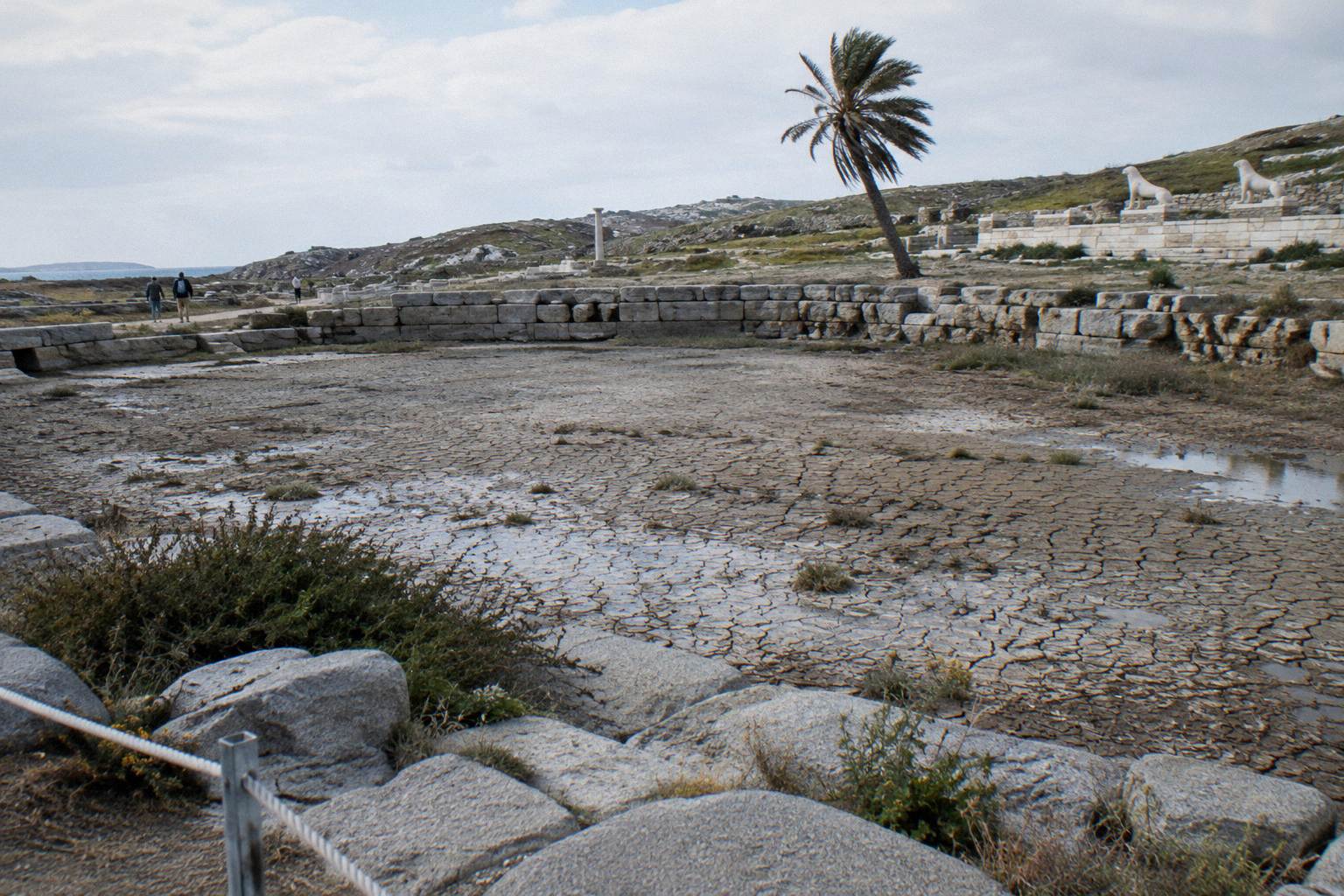
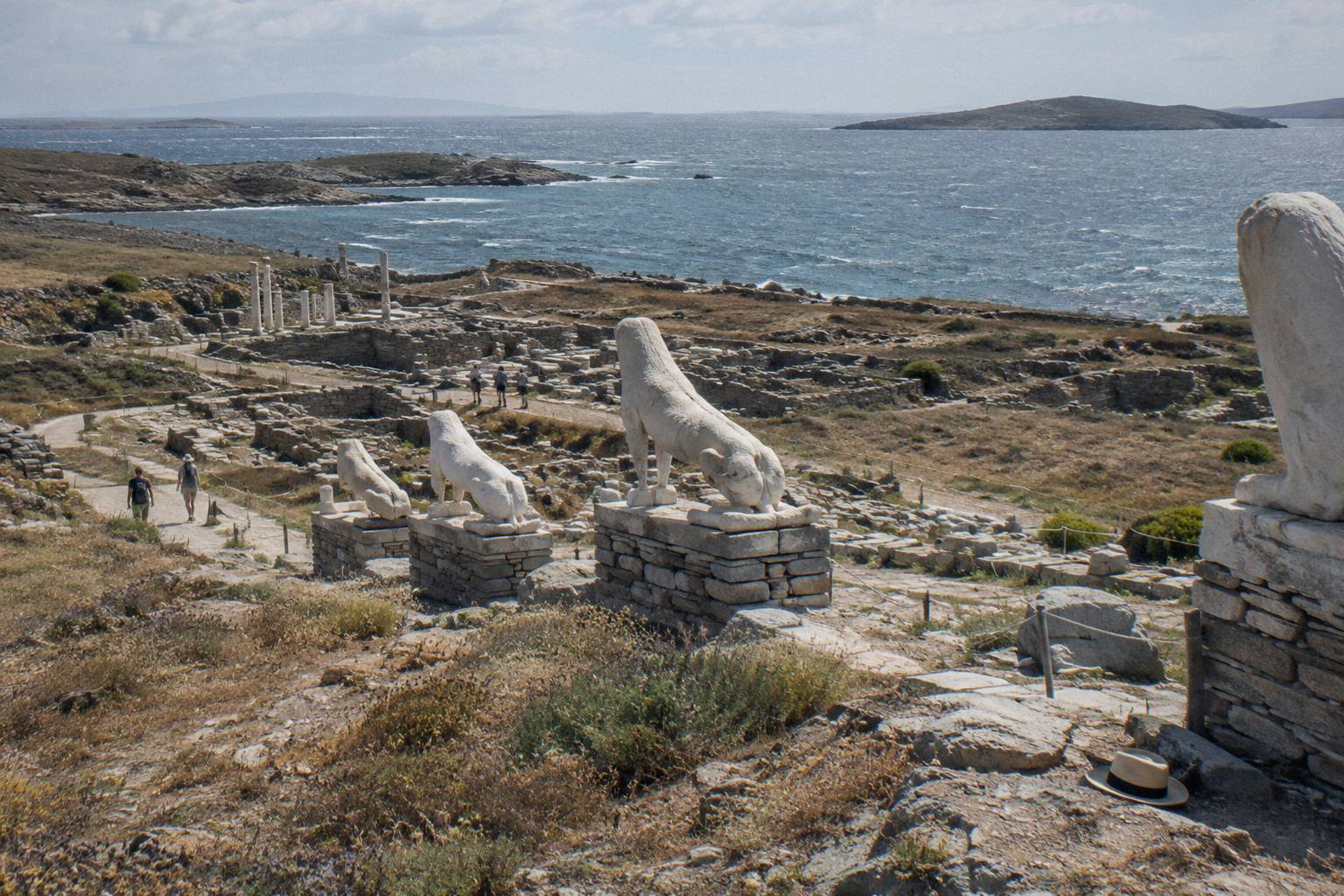
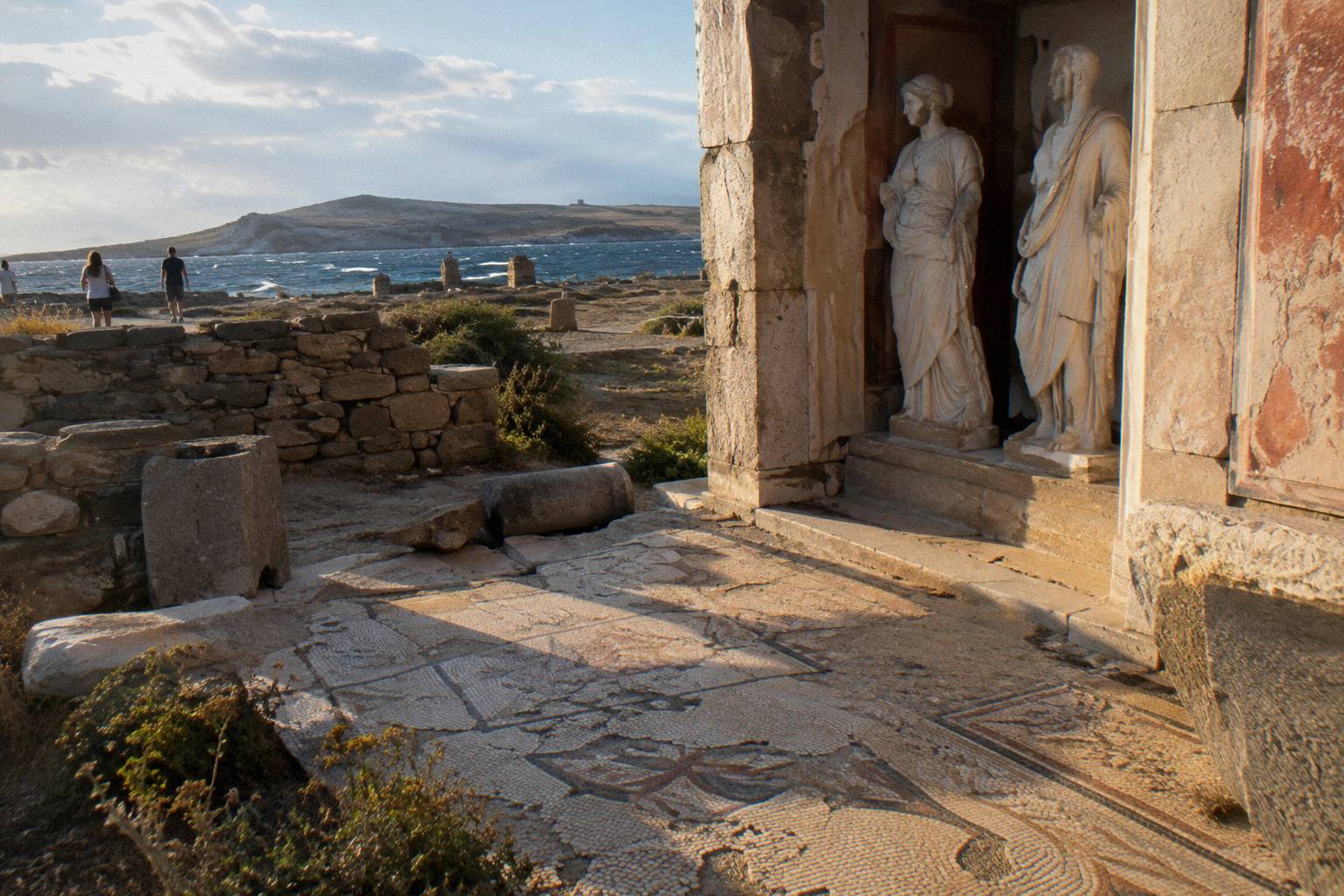
What a visitor sees today is the residue of that sacred period. The famous Naxian Lions were erected in the late 7th or early 6th century BC; the lions standing on the terrace now are exact replicas, with the originals moved into the Archaeological Museum in 2000 to protect them from the weather and the air. The Sacred Lake, central to the Apollo cult and once fringed with palm trees in ancient descriptions, is dry today, a flat grassy basin beside the lion terrace. Hellenistic houses survive with mosaic floors and frescoes, belonging to wealthy merchants of the island's trading age, and Mount Kynthos rises as a sanctuary hill with views over the whole site and across the water to Mykonos and Rhenia. None of it is inhabited, and none of it can be.
There is a useful way to hold all of this in mind while walking the site: Delos is not a ruin that people left, it is a ruin that people were required to leave, first by religious law and then by force. Modern Greek protection law continues the ancient logic. The island belongs to the archaeological service, entry is by ticket, and when the ticket office closes, the island closes with it.
Can A Tour Stay Overnight On Delos At All?
No tour stays overnight on Delos, and no listing in this site's roster claims otherwise. The island is an uninhabited archaeological site with no accommodation, so every product sold, from the €60 budget half-day to the €2,500 private full-day boat, returns to its departure island the same day. The closest thing to a late visit is a sunset cruise, and even that sails home.
Worth being precise about what "late" means here. The Sunset Cruise With Dinner from Sunfos Alessia Yachting runs 5 hours and costs from €115 per person, visits Delos and Rhenia, ends with dinner on the water, and is rated 4.7 across 119 reviews with free cancellation up to 24 hours ahead. It is still a round trip back to Mykonos the same evening, collecting from the Old Port and the New Port. It is the evening option, not an overnight option, and its listing shows the Delos site ticket as an extra at the official rate.
The boat logistics explain the hard limit. The crossing from Mykonos Old Port takes about 30 to 40 minutes, and boats run on a schedule, not on demand. There is no ferry pier with a 24-hour service, no water taxi rank, no late-night rescue circuit. One recent pattern in guest reviews is worth knowing: people who visit independently sometimes underestimate how firm the last return is, and how quickly a large open site eats an afternoon. With a tour, the return is your operator's problem, which is precisely why first-time visitors usually book one.
A note on the site itself, since day visitors sometimes arrive unprepared: the Ministry of Culture's official Delos ticket page states that visitors may not swim off the coast of Delos, that water vending machines sit at the port and at the Museum, and that assistance dogs and therapy animals are allowed with documents. The site ticket is €20 full and €10 reduced, it covers the Archaeological Museum, and it never includes any boat. If your operator's listing shows the ticket as an extra, budget it separately; many roster rows, including most of the popular cruise options, price it that way. Beware of older figures: some listings still quote a €12 entrance, which is the old rate and not the current one.
| Closure or free-entry rule | Dates |
|---|---|
| Closed | 1 January, 25 March, 1 May, Easter Sunday, 25 December, 26 December |
| Free admission | 6 March, 18 April, 18 May, 28 October |
| Free admission | Last weekend of September (European Heritage Days) |
| Free admission | Every first Sunday, 1 November to 31 March |
If a closure day coincides with your plans, boats may still run but the site will be shut, so check the day before you go; no seasonal hours table is published on the official page, and this site does not guess at one. A tour operator will usually move or refund you if the site is closed, and most roster rows carry free cancellation up to 24 hours ahead, which covers exactly this kind of surprise. The free-admission days are a genuinely useful perk if your dates align: the ticket is waived, though the boat fare still applies, and those days can be busier as a result.
How Do You Work Out The Last Boat Without An Overnight Option?
Every tour bakes the return crossing into its duration, so the last-boat question disappears the moment you book one. The MTM Guided Day Trip runs 4 hours from Mykonos with the Delos ticket listed as included, from €101 per person. The 35-Minute Boat Transfer Only from Delos Travel sells a round trip from €29 per person and leaves the timing discipline to you.
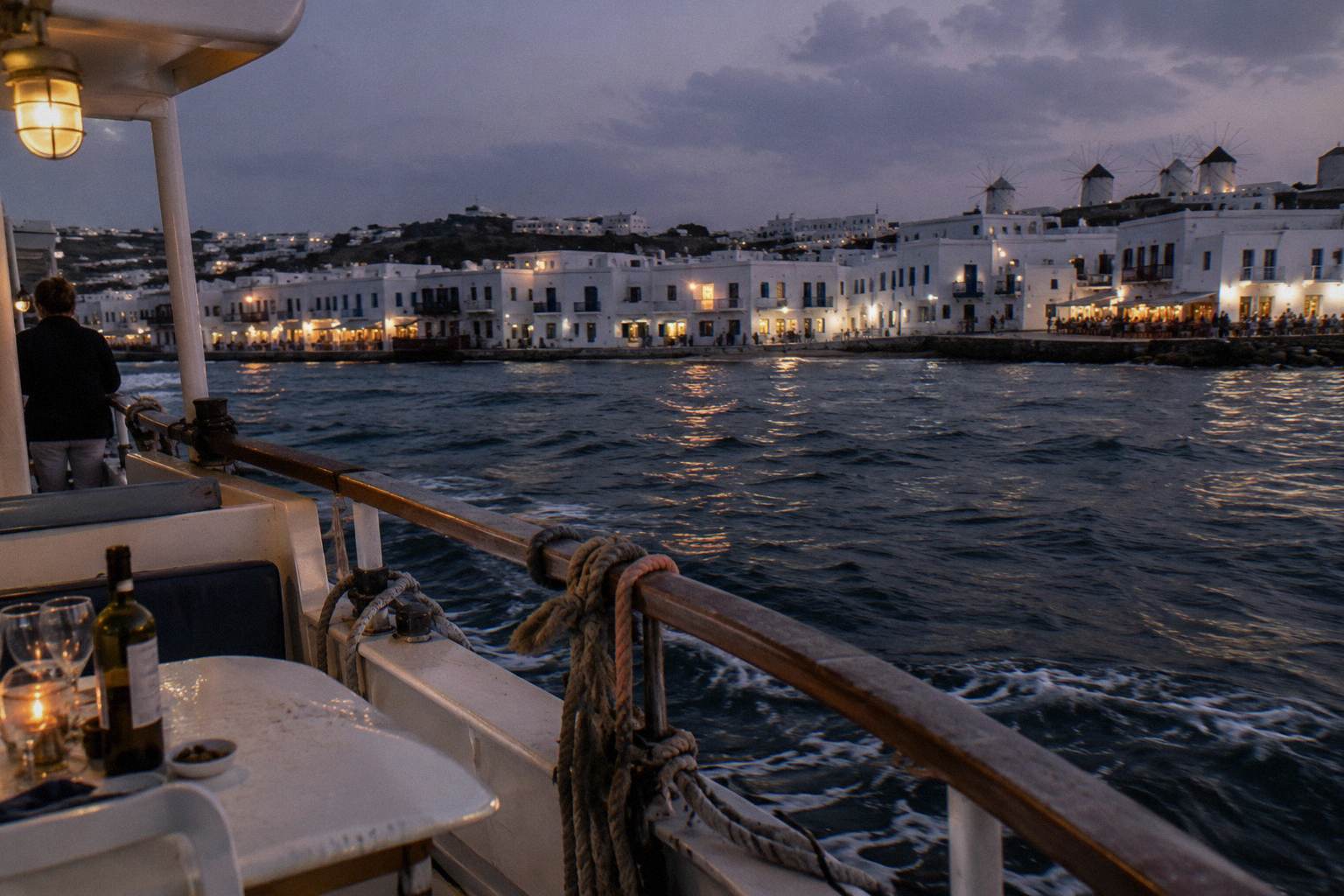
Two philosophies sit behind that comparison. The guided day trip, from MTM Experiences, is rated 3.7 across 111 reviews, includes a licensed guide and covers the whole outing in 4 hours: you join at Mykonos Old Port or New Port, cross, tour, and come back with the group. Nothing to work out, no schedule to memorise, and the site ticket is already in the price you paid. It is the choice for anyone whose main worry on this page, the return leg, is precisely what they do not want to think about.
The transfer-only route is the budget alternative with the most responsibility attached. Delos Travel's 35-Minute Boat Transfer Only, from €29 per person from Mykonos Old Port, sells you the round-trip crossing and nothing else: the booked duration of 35 minutes describes the crossing itself, not a day on the island, so your total outing depends entirely on which return sailing you pick. The Delos site ticket is an extra at the official €20 full or €10 reduced rate, a guide is optional at the entrance, and the return sailing time is the number you must pin down before you wander off toward Mount Kynthos. Free cancellation applies up to 24 hours ahead. This row has no reviews yet, so we print no rating.
The transfer-only route also has a private-boat cousin worth knowing about for groups. Several operators in the roster, including Don Blue Yachting, sell private boats by the hull rather than by the seat, which changes the last-boat arithmetic completely: on a private charter, the boat waits for you. The Don Blue 3-Hour Private Cruise runs from €750 per boat, rated 5 across 38 reviews, and the 8-hour Private Speedboat from the same operator runs from €1,650 per boat, rated 5 across 55 reviews. Both visit Delos and Rhenia, both list the Delos ticket as an extra, and both return to Mykonos the same day, because even a private charter cannot anchor overnight at an uninhabited protected site.
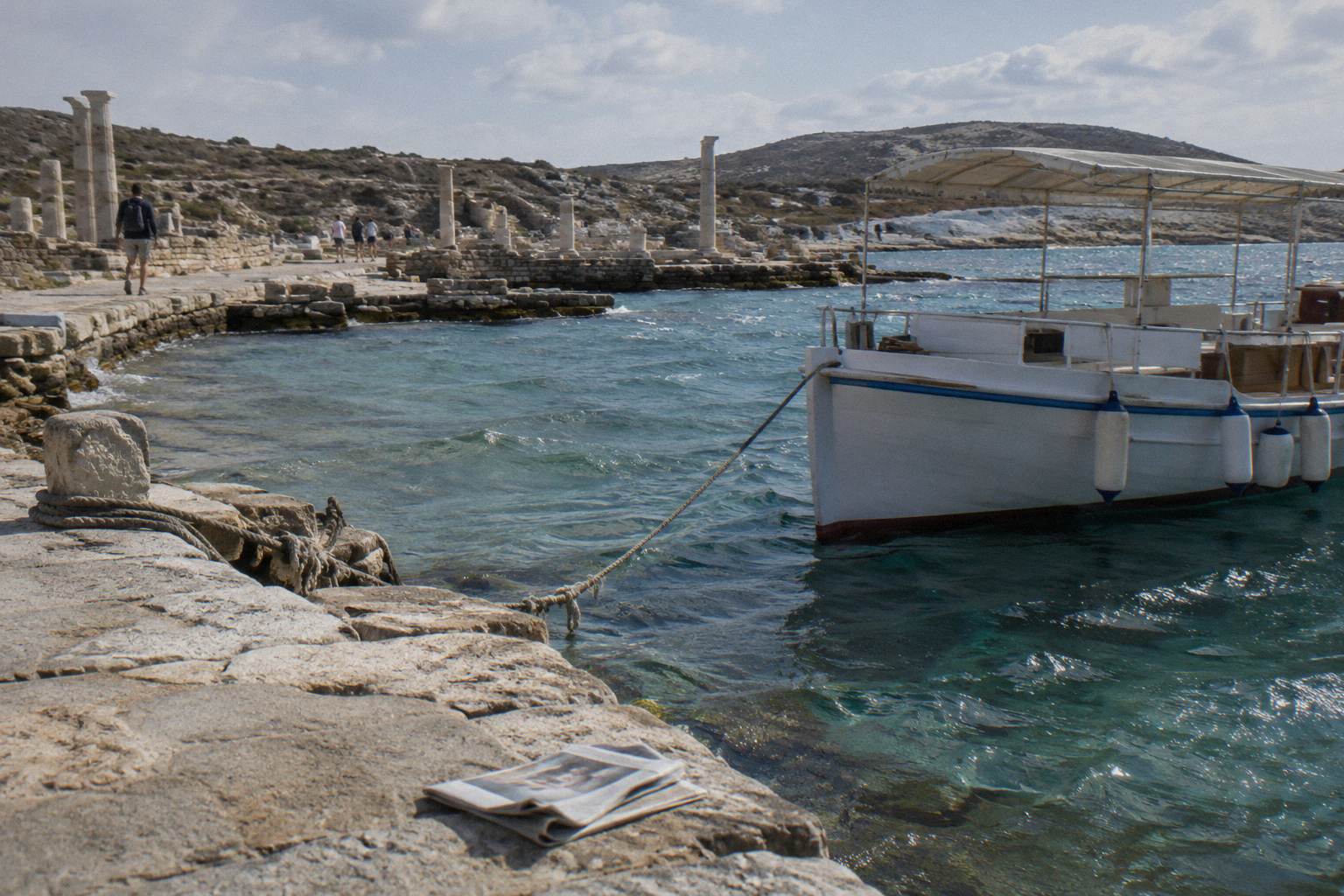
The independently minded middle ground is a cruise that mixes Delos with Rhenia. These are the rows that run longest, typically 6 to 7 hours, with a swim stop and a meal on or beside Rhenia, which is where swimming is actually allowed, since it is banned off Delos itself. The most reviewed option on this site is the Rhenia Cruise With Lunch from Aegean Ventures Mykonos, 6.5 hours, from €88 per person, rated 4.6 across 1,764 reviews, with the Delos ticket listed as included and free cancellation up to 24 hours ahead. It departs from Mykonos Old Port and still comes home the same day; every one of these cruises does. For a fuller picture of what the Rhenia stop actually involves, our guide to what happens on a Delos and Rhenia cruise walks through the whole outing hour by hour.
| Tour | Whole-tour length | From | Delos ticket | Same-day return |
|---|---|---|---|---|
| Budget Half-Day Guided Tour (Delos Travel) | 4 hours | €60 per person | Not stated on listing | Yes, to Mykonos |
| MTM Guided Day Trip (MTM Experiences) | 4 hours | €101 per person | Included | Yes, to Mykonos |
| 35-Minute Boat Transfer Only (Delos Travel) | 35 minutes crossing | €29 per person | Extra (€20 full / €10 reduced) | Yes, you choose the sailing |
| Rhenia Cruise With Lunch (Aegean Ventures Mykonos) | 6.5 hours | €88 per person | Included | Yes, to Mykonos |
| Day Cruise From Naxos (MTM Experiences) | 10 hours | €90 per person | Extra (€20 full / €10 reduced) | Yes, to Naxos |
The Naxos row is a useful reality check on scale: a 10-hour day from Naxos, rated 3.4 across 36 reviews, still returns the same evening. Distance changes the length of the day, never the overnight rule. The same applies from Paros, where the 10-hour cruise from MTM Experiences (from €90 per person, rated 3.4 across 18 reviews) and the 9-hour Paros Day Cruise (from €70 per person, no reviews yet) follow the identical pattern: out in the morning, home at night, Delos empty again behind you.
What Should You Pack For A Day With Nowhere To Buy Anything?
Bring everything you need for the whole crossing and the whole site, because Delos has no shops, no cafe and no accommodation: the only facilities are water vending machines at the port and at the Museum. Sun protection matters most, the site is open and almost treeless, and swimming is banned off Delos itself.
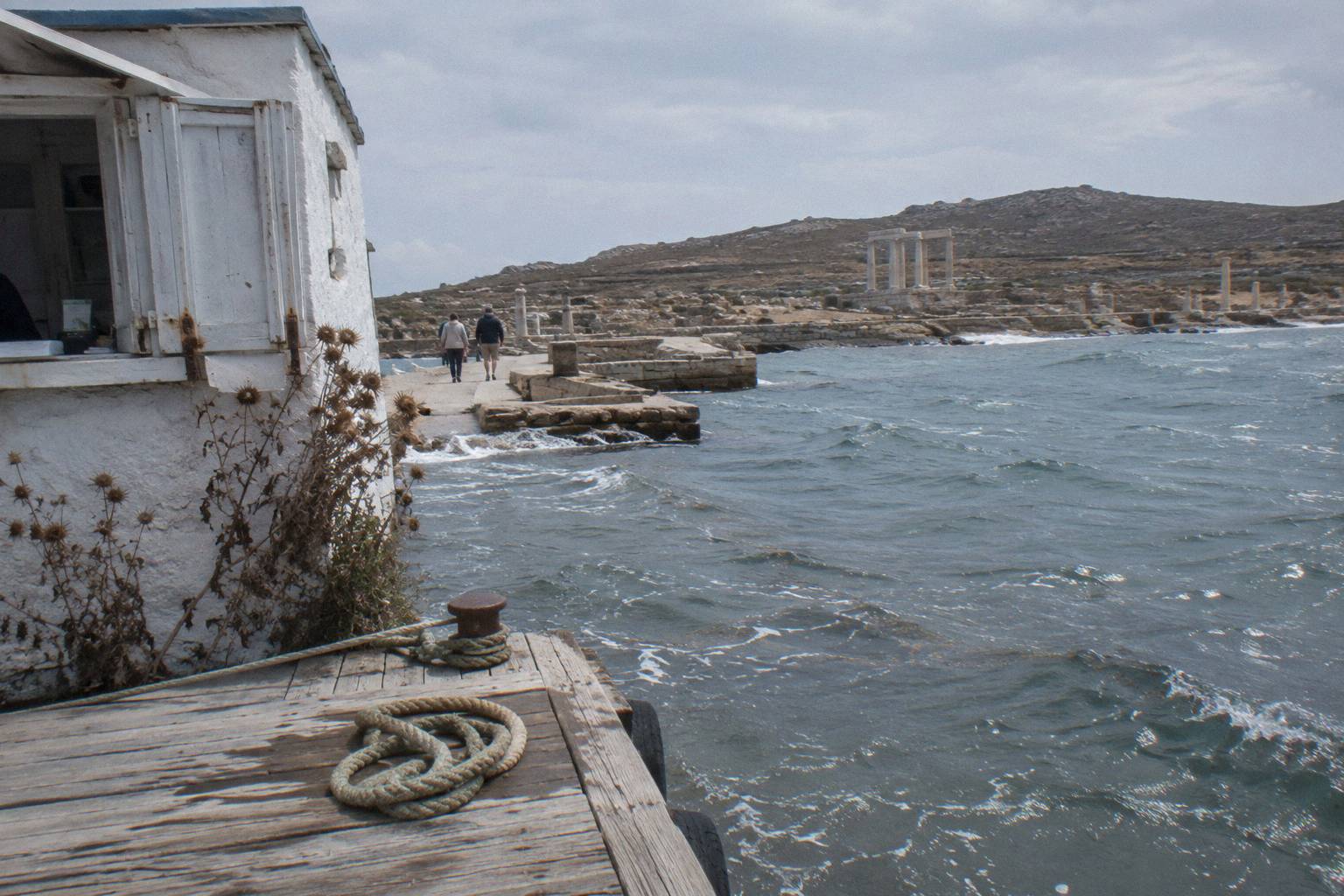
The no-residents rule has a mundane side that catches people out. On an island where nobody lives, there is no bakery, no kiosk, no taverna and no shaded cafe to retreat into at midday. The vending machines at the port and the Museum are the entire retail economy of Delos. Most tours solve this partly: the cruise rows serve lunch and drinks on board, and the Sail Cruise, Lunch And Drinks from Sunfos Alessia Yachting (5 to 6 hours, from €115 per person, rated 4.6 across 653 reviews, licensed guide included) puts the meal on the boat rather than expecting you to find one on the island. On a bare-bones guided half-day, you are on your own for food and water.
The practical list is short but non-negotiable: a refillable bottle, more water than feels reasonable in summer, a hat and sunscreen for a site with almost no shade, and sturdy shoes for uneven marble paths that have been underfoot for over two millennia. The climb up Mount Kynthos, a sanctuary hill with wide views, is exposed and rocky; the payoff is the best perspective on the whole layout of the ancient city and across the strait to Rhenia. Leave the swimsuit in the bag unless your itinerary stops at Rhenia: swimming off Delos is prohibited, and the rule is enforced, not advisory. Our full checklist for what to wear and bring on a Delos tour goes into more detail by season.
One more timing note belongs here. Because the island empties with the last boats, the site is at its quietest early and late in the day, and the light on the lion terrace in the final hour before closing is a photographer's favourite. A sunset-adjacent visit is possible with the evening cruise rows; a visit after the boats stop is not possible at all, and no packing list changes that.
If you are weighing up whether the visit justifies its cost at all, our breakdown of whether a Delos tour is worth it from Mykonos runs the numbers against the ferry-plus-ticket DIY route, including the €25 round-trip boat fare that the local operator quotes independently of the tours above. For cruise passengers, the arithmetic shifts slightly: your ship is your overnight, and shore options like the From Cruise Port, 5 Hours tour from Delos Travel (from €65 per person, rated 4.1 across 51 reviews, Delos ticket included, free cancellation 24 hours ahead) are built around the ship's departure, not Delos's last boat. Same principle, different clock.
Common Questions About Staying Overnight On Delos
Why Does No One Live On Delos, And Can A Tour Stay Overnight?
Delos has been uninhabited since the 7th century AD, after sacks in 88 BC and 69 BC ended its ancient prosperity, and it is now a protected archaeological site with no accommodation. No tour stays overnight: every listed option, from the 4-hour Budget Half-Day Guided Tour to 9-hour private boats, returns to its departure island the same day.
Was Anyone Ever Allowed To Be Born Or Die On Delos?
No, at one stage of antiquity. The Ephorate of Antiquities of the Cyclades records that births and deaths were forbidden on the island and the inhabitants were exiled, a purification tied to the cult of Apollo. The dead were buried across the water on Rhenia, which forms part of the same World Heritage listing.
Can I Sleep On A Boat Anchored Off Delos Instead?
None of the tours in this site's roster offers that, and no listing claims overnight anchorage at Delos. Private charters, including the 8-hour Private Speedboat from Don Blue Yachting (from €1,650 per boat), run as daytime round trips back to Mykonos.
What Happens If I Miss The Last Boat From Delos?
There is no accommodation and no overnight stay on the island, so a missed last boat is a serious problem rather than an adventure. Booking a guided tour or cruise removes the risk entirely, since the return crossing is part of the product; independent visitors on the transfer-only ticket must confirm return sailing times before leaving the jetty area.
Is The Delos Museum Or Anywhere On The Island Open In The Evening?
No seasonal evening hours are published on the official Ministry of Culture page, so check the day before you go rather than assuming late access. The site ticket (€20 full, €10 reduced) covers the Archaeological Museum, where the original Naxian Lions have been kept since 2000, but the whole site empties with the last boats.
Can I Swim Or Camp On Delos While I Wait For The Boat?
Swimming off the coast of Delos is prohibited, and camping is impossible on an uninhabited protected site. Swims happen on neighbouring Rhenia on the cruise itineraries that stop there; on Delos itself, the only facilities are water vending machines at the port and the Museum.